
Overview
Interaction design · Designed Minds Workshop 6
Perspective
A playable metaphor for criteria, possibilities, and human judgment.
I turned an abstract AI decision-making concept into a browser physics game, then questioned a mechanic that could teach the wrong lesson.
- My contribution
- Game concept, mechanics, tutorial, debrief, and implementation direction
- Context
- Designed Minds Workshop 6 · collaborative workshop planning
- Implementation
- Browser-based HTML/CSS/JavaScript · Matter.js · GitHub Pages documented
- Interaction scope
- Primarily desktop, with mouse-driven vertical bars
- AI involvement
- I vibe-coded the game with Codex in Visual Studio. I defined the metaphor and evaluated mechanics, language, and output.
- Product boundary
- A designed metaphor for AI ideation—not a live AI decision engine or a validated scientific model.
Problem
Make criteria tangible without teaching that exploration is wrong.
Workshop planning narrowed toward decision-making during AI ideation. More options can help exploration, yet create more judgment work when someone needs to choose. The game had to communicate that distinction without presenting convergence as universally better.
The documented metaphor
- 01Idea balls = possibilities
- 02Funnel = criteria
- 03Bars = human judgment
- 04Bucket = ideas to consider
The bucket represents relevance for further evaluation, not objectively better ideas.
Decisions
Make the mechanic communicate the intended lesson.
01/04Compare fairly
Change the possibility space. Keep the goal and controls.
I created broad- and focused-funnel versions with the same player, bucket, goal, and two-bar control. The intended comparison is the effect of clearer criteria, not an easier second game.
Broad possibility space
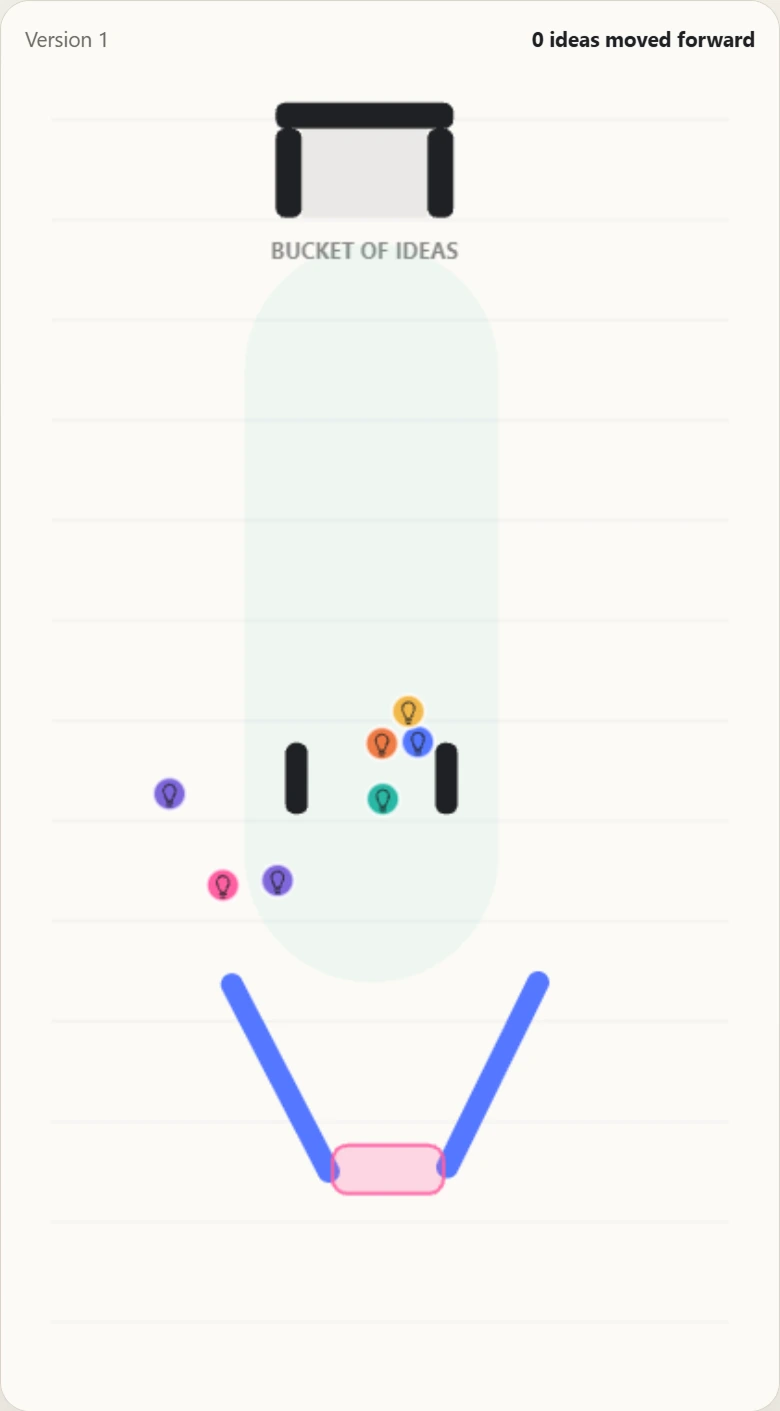
Focused possibility space
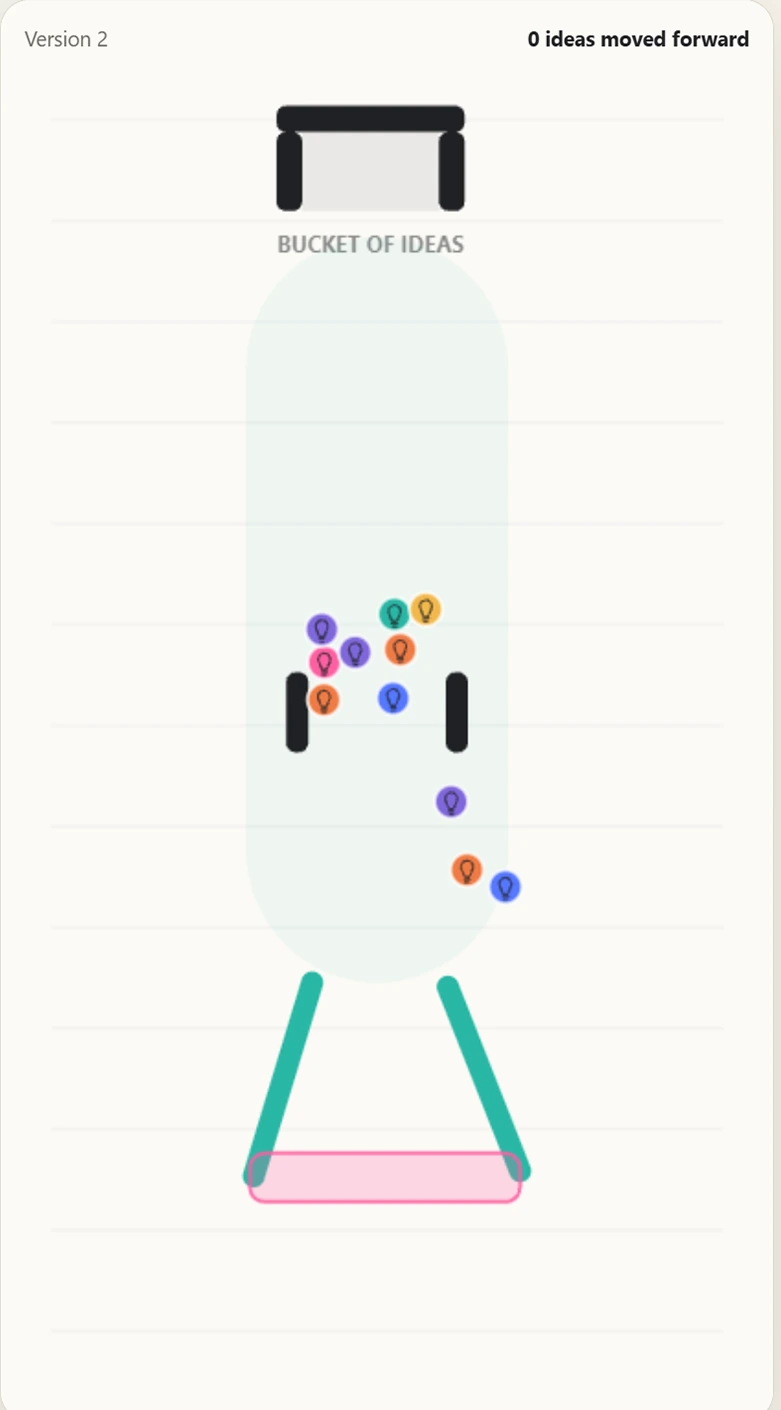
Sequence: Version 2 unlocks after Version 1; after both, the comparison appears. Play Again resets the experience. The dinner example in the source explains the same principle: human choices such as cuisine and available ingredients shape what remains for AI to explore.
02/04Critique the mechanic
Do not let scoring contradict the metaphor.
Bar collisions could create extra idea balls, giving the broad version more scoring opportunities. I questioned multiplication caused by the judgment bars and refined the direction toward separating possibility generation from steering.
Conceptual correction, not a test result
- 01Notice the score contradiction
- 02Locate the extra ball generation
- 03Keep judgment focused on steering
My judgment: do not enlarge the second bucket or rewrite scores just to force the intended result. A physics-based score cannot establish idea quality.
03/04Align language and meaning
Score “ideas moved forward,” not “balls caught.”
I revised the result language and debrief to emphasize relevance to a decision. “Broad” and “focused possibility space” keep both modes legitimate; the person still guides what progresses.
Existing comparison screen
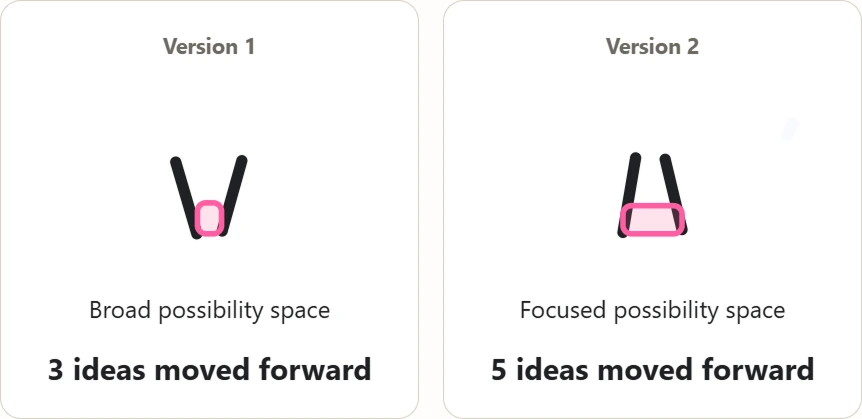
Debrief: ask what changed, where exploration helped, and what the player still had to do. AI can expand the space; criteria shape it; human judgment remains responsible for the choice.
04/04Teach through interaction
Introduce the controls before the theory.
A visual tutorial demonstrates launch, bar movement, guidance, and the bucket goal. The conceptual explanation follows play, so participants can first experience the contrast.
Launch an idea

Move the bars
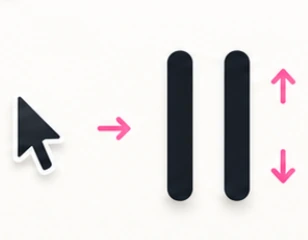
Guide the ideas
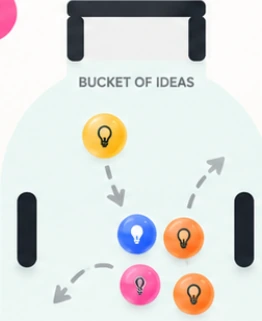
Move ideas forward
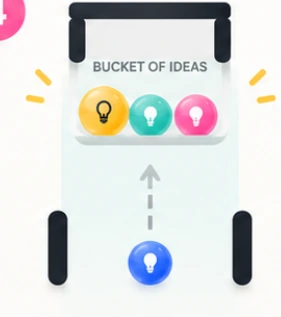
AI support, with direction and review kept human
- Objective
Make an abstract workshop concept playable.
- AI contribution
Codex supported coding in Visual Studio, as confirmed by the project author.
- My judgment
I defined the metaphor, reviewed mechanics, and refined score language and the teaching direction.
- Result
A browser game and tutorial; the record does not establish participant-learning gains.
Impact
A working activity—and a sharper test of what mechanics communicate.
The project delivered the two-version game, visual tutorial, comparison screen, and debrief framing.
- Technical delivery
- The source documents a configurable browser 2D physics implementation using Matter.js and a static GitHub Pages deployment.
- Workshop integration
- The activity connects to the workshop’s discussions of AI steering and decision quality. Workshop planning was collaborative; my documented contribution covers the game and its interaction/facilitation framing.
- Evidence limit
- No measured participant learning, engagement, satisfaction, or usability results are documented. A higher score is not proof of better ideas, and the game does not literally model an LLM.
Every mechanic communicates a claim.
A functional interaction can still teach the wrong model. This project taught me to review what the system rewards as carefully as how it plays.