
Overview
Product design + development · Designed Minds
Mindle
The puzzle was the invitation. Participation was the challenge.
I built a weekly UX word game that connects guessing, a short lesson, and reflection. Later iterations explored making the check-in more relevant and giving members clearer control over sharing.
- My role
- Product designer and developer
- Context
- Designed Minds community · June–October 2026 project record
- Platform
- Responsive web app · deployed on Vercel
- Stack
- Next.js, React, TypeScript, Tailwind CSS, Supabase/PostgreSQL
- AI involvement
- Cursor supported development; I owned product direction, privacy decisions, scope, and output review.
- Evidence status
- Production core documented; later reflection, identity, streak, and analytics directions remain distinct from verified deployment.
Problem
Sharing required effort before members received any value.
Community members had work to share, but open-ended prompts asked them to recall their week, choose a story, and decide whether to make it public. The record notes about two reflections over one month—not an inactive community, but a participation opportunity.
Product hypothesis
- 01Guess a UX word
- 02Learn the concept
- 03Reflect on your work
- 04Choose what to share
The loop is a product hypothesis. It does not establish that a puzzle causes a sustained sharing habit.
Decisions
Make participation a smaller next step.
01/04Invite · Support
Use a familiar game with optional help.
I chose letter and full-word guessing with 13 attempts, three progressive hints, and configurable prefilled letters. The lesson follows the result, connecting the puzzle to a useful UX concept.
Recorded game interface
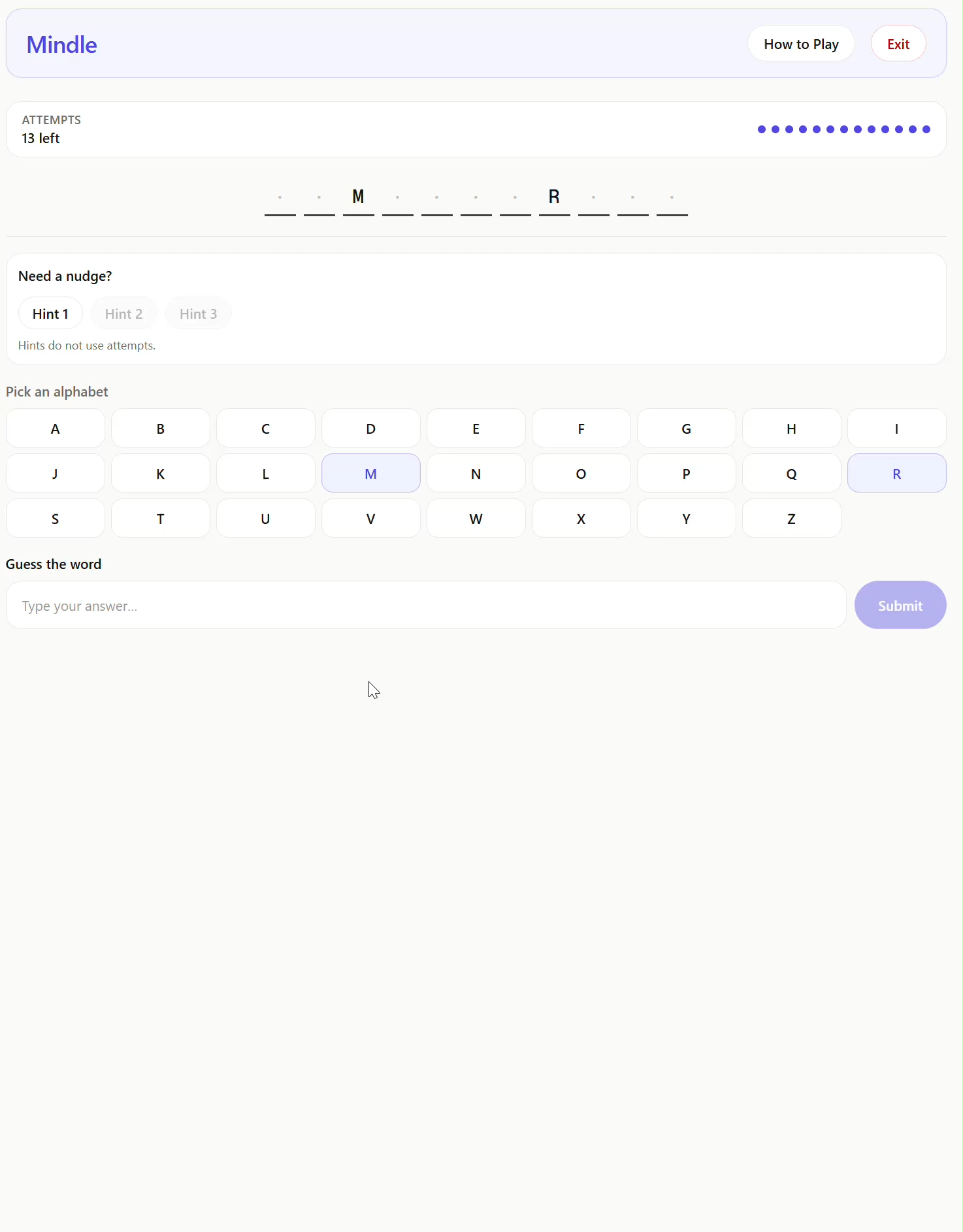
Trade-off: familiar mechanics reduce the need to learn a new game, but vocabulary still affects difficulty. Content-level hints and prefilled letters provide support without changing the rules.
02/04Reflect · Later design direction
Replace two broad questions with one relevant check-in.
The original reflection asked what players built and what challenged them. I selected a four-category check-in so a learner, someone making progress, or someone needing help would have a relevant starting point.
Original reflection
What did you build this week?
What challenges did you face?
Selected redesign
- Made progress → What moved forward?
- Hit a challenge → What are you figuring out?
- Learned something → What could help someone else?
- Need help → Where would you like input?
Scope: only the relevant follow-up would appear. The adaptive flow is a documented later decision; its production deployment and effect on response rates are not established here.
03/04Identity · Privacy direction
Separate trying the game from public participation.
I selected an immediate-play direction with identity requested when relevant to sharing. The reflection design offered named, anonymous, and private responses, with the consequences disclosed before submission.
Selected sharing options · Deployment not verified
- 01Share with your name
- 02Share anonymously
- 03Keep the reflection private
Trade-offs: browser identity can be lost across devices or storage resets. Private contributions do not become community content. A proposed reflection streak would count every visibility choice—not reward agreement to public sharing.
04/04Operate · Measure
Design the weekly operation alongside the player flow.
I built an admin workflow for words, hints, lessons, prefilled letters, and timezone-aware scheduling. A later six-event funnel was selected to locate drop-off without collecting every click.
Proposed analytics milestones · Instrumentation not verified
- 01Game started
- 02Game completed
- 03Reflection viewed
- 04Category selected
- 05Response started
- 06Reflection submitted
Technical contribution: the record documents Server Actions, Supabase persistence, signed gameplay state, and server-side admin secrets. The reflection schema direction preserves older responses. A Friday roundup strategy connects last week’s lesson, community highlights, and the next puzzle without spoilers.
AI support, with direction and review kept human
- Objective
Build and iterate a weekly learning product.
- AI contribution
Cursor supported scoped implementation changes.
- My judgment
I set behavior, inspected existing implementation, reviewed changes, and retained responsibility for UX and privacy.
- Result
A documented production core; later product directions are labeled rather than assumed shipped.
Impact
A production core, with early signals worth investigating.
The record supports a shipped game, persistent results/reflections, admin content scheduling, and Vercel deployment. It does not establish a causal engagement lift.
- Early reflection signal
- 2 reflections over approximately one month before launch; 3 over the first two weeks afterward. Different windows and a small sample prevent a causal or sustained-habit claim.
- July 6, 2026 snapshot
- 7 non-seed registered players and 6 scheduled concepts. Earlier test-player deletion also removed related results, so retained rows are not lifetime completions.
- What remains to validate
- Adaptive reflection, sharing controls, browser identity, streak behavior, and the proposed event funnel need deployment verification and follow-up evaluation. No WCAG conformance is claimed.
The next question is what happens after the puzzle.
I want to understand contribution quality and whether reflections lead to useful support or conversation. Completion alone cannot answer that.